
Views: 0 Author: Site Editor Publish Time: 2026-03-25 Origin: Site


The electric power system of a drone consists of a battery, an electronic speed controller (ESC), a motor, and propellers. The battery powers the entire system, the ESC receives flight control signals and adjusts the motor speed, and the motor's rotation drives the propellers to generate lift for flight.
Lithium Polymer Battery
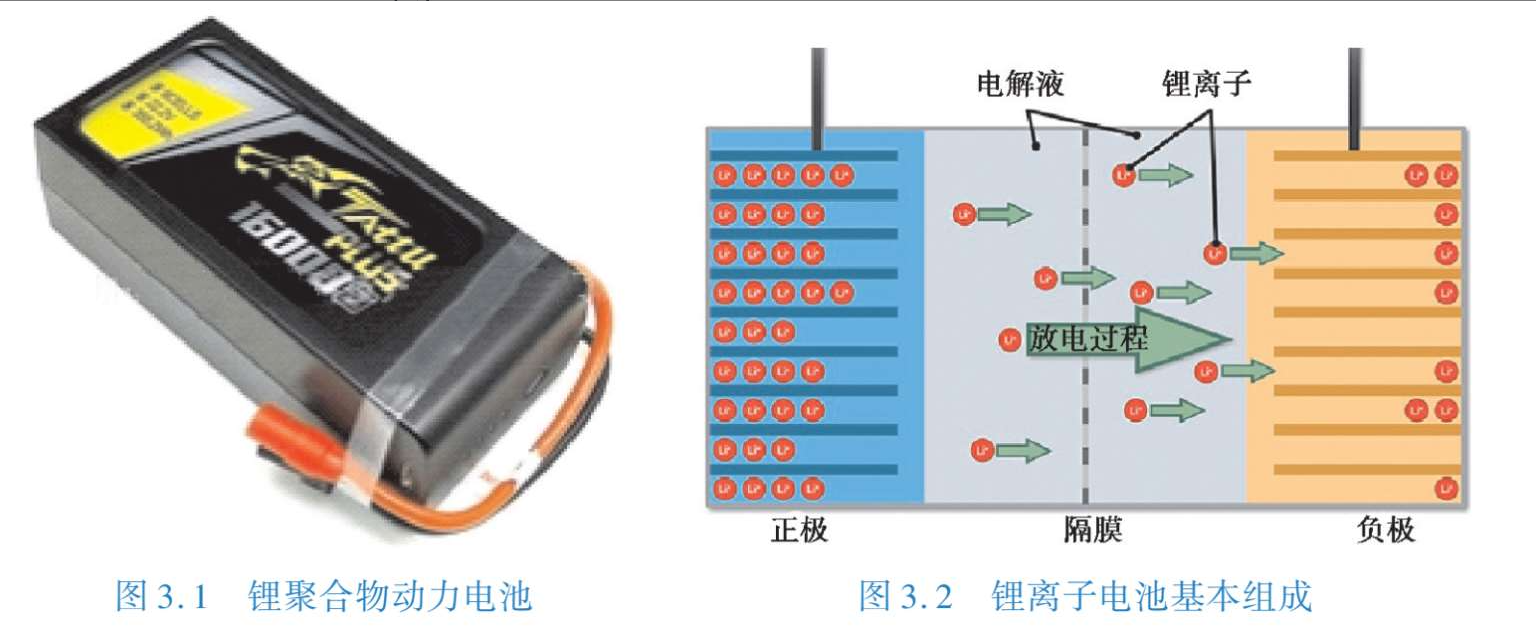
Batteries primarily provide energy for drones and include nickel-cadmium, nickel-metal hydride, and lithium batteries. Considering battery quality and efficiency, multi-rotor drones mostly use lithium polymer batteries, as shown in Figure 1.
(1) Overview
Batteries using materials containing metallic lithium as electrodes are collectively called lithium batteries, including lithium metal batteries (early, non-rechargeable) and lithium-ion batteries. Like other batteries, lithium-ion batteries also consist of electrodes and electrolytes, as shown in Figure 3.2.
Lithium-ion batteries come in two forms: liquid lithium-ion batteries (LIB) and polymer lithium-ion batteries (LIP). The difference lies in the electrolyte; the former uses a liquid electrolyte, while the latter uses a polymer electrolyte. This polymer can be in a "dry" or "gel" state, but currently, most use polymer gel electrolytes.
1) Advantages
Lithium polymer batteries have been chosen as the mainstream power source for multi-rotor drones primarily due to their unique advantages, specifically:
High Voltage: The operating voltage of a single battery is as high as 3.6 ~ 3.8 V, far exceeding the 1.2 V of nickel-metal hydride and nickel-cadmium batteries;
Large Capacity: The capacity density of polymer lithium batteries is 1.5 ~ 1/3 of that of nickel-metal hydride or nickel-cadmium batteries. 2.5 times, or even more, its ultra-high battery capacity has long made it the preferred choice for laptops and smartphones;
Low self-discharge: Its capacity loss is minimal even after prolonged storage;
Long lifespan: Its cycle life under normal use can reach over 500 cycles;
No memory effect: No need to completely discharge the remaining power before charging, making it convenient to use (NiCd batteries have a memory effect);
Good safety performance and lightweight: Polymer lithium batteries use an aluminum-plastic soft-pack design, unlike the metal casing of liquid batteries. In the event of a safety hazard, liquid batteries are prone to explosion, while polymer batteries will at most bulge. Therefore, the protection circuit design can omit PTC and fuses, saving battery costs. At the same time, the aluminum-plastic soft-pack is obviously much lighter than a metal casing;
Thin: Polymer lithium batteries can be less than 1 mm thick, even allowing them to be assembled into a credit card. While conventional liquid lithium batteries face technical bottlenecks when their thickness falls below 3.6 mm, polymer cells exhibit several advantages:
Low internal resistance: Polymer cells have lower internal resistance than conventional liquid cells, significantly reducing self-discharge and extending phone standby time, making them a new option for remote control models.
Customizable shape: Cell thickness can be increased or decreased according to customer needs, allowing for the development of new cell models. Mold development cycles are short, and some cells can even be custom-made to fit the phone's shape, maximizing battery capacity by utilizing the battery casing space.
Excellent discharge characteristics: Polymer batteries use a gel electrolyte, offering more stable discharge characteristics and a higher discharge platform compared to liquid electrolytes.
Strong environmental adaptability and environmentally friendly: They can operate from -25 to 55°C, making them suitable for low-temperature use. Furthermore, lithium-ion batteries do not contain toxic substances, hence the term "green battery," receiving significant government support.
2) Disadvantages
High battery cost: Due to the difficulty in purifying the electrolyte system.
Requires protection circuit control: Overcharging or over-discharging can disrupt the reversibility of the battery's internal chemical substances, severely impacting battery life.
(2) Battery Voltage and its Correct Use
Voltage represents the voltage drop between the positive and negative terminals of a battery. The effective voltage range of a single lithium-ion battery is generally considered to be 2.75~4.2 V. Below 2.75 V, it is considered to have no capacity, and in reality, below 3.0 V, the battery has virtually no capacity. Therefore, for correct use, the following basic concepts should be understood:
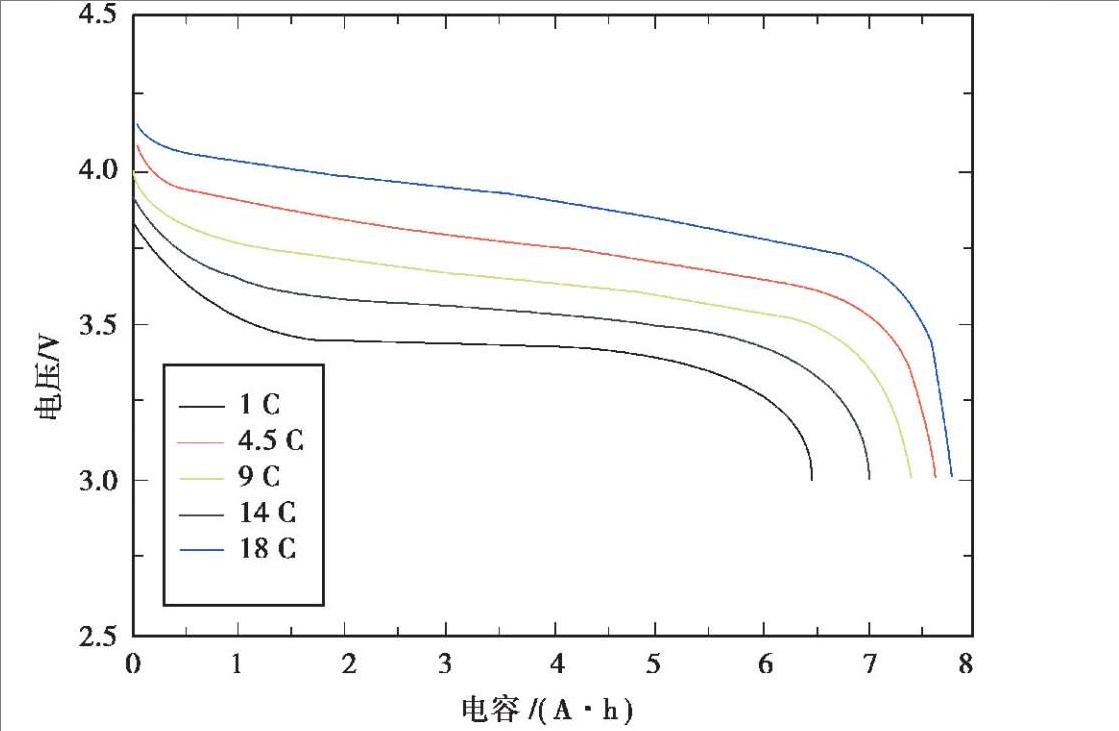
1) Nominal Voltage The nominal voltage, also known as the rated voltage, is currently the rated voltage of 3.7 V for industrially produced lithium polymer batteries. During the discharge process from full charge voltage to discharge termination voltage, the voltage value is not linear, but a curve, as shown in Figure 3.3. At the beginning of discharge, the voltage decreases at a rate close to linear, gradually leveling off at 3.7 V and remaining there for a relatively long time, before rapidly decreasing again. Therefore, around 3.7 V is the optimal operating range for a single lithium polymer battery. For this reason, in practical engineering applications, the alarm voltage is usually set to 3.6 V, and should not be lower than 3.5 V, to effectively extend the battery's lifespan.
2) Discharge Termination Voltage
Discharge automatically terminates at this voltage, meaning the battery will stop working. This voltage is typically 2.5~2.75V, though different manufacturers may set it slightly differently. Continuing to discharge below this voltage is called over-discharge, which will shorten battery life or even cause failure. Because model aircraft batteries are used under load, the voltage will be lower than the measured value when at rest. Therefore, if the measured voltage is 2.8~3V after the load is removed, the battery may have already been over-discharged during use. The safest usage is to measure a voltage above 3.55V after use; the real-time voltage alarm can usually be set around 3.5V.
3) Full Charge Voltage
Full charge voltage is the voltage of a single battery cell when fully charged. A full charge voltage is generally 4.2V. Continuing to charge above 4.2V is overcharge, which will also affect battery life.
Note: Both overcharging and over-discharging will cause violent chemical reactions inside the lithium battery. Gas will be generated inside the battery, causing expansion that is irreversible. In severe cases, it may even lead to combustion or explosion. Therefore, it is crucial to strictly adhere to safe operating procedures when charging and discharging lithium polymer batteries to avoid accidents.
4) Battery "S" and "P" Numbers
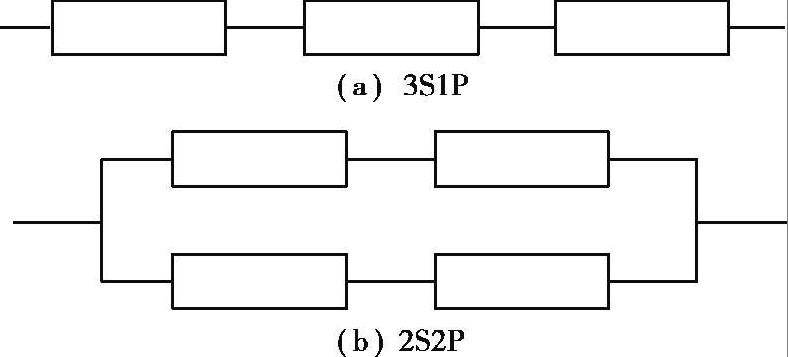
To achieve higher operating voltage and capacity, individual cells must be connected in series or parallel to form a lithium polymer battery pack, as shown in Figure 3.4. The number of cells connected in series is represented by the "S" number, and the number of cells connected in parallel is represented by the "P" number. For example, 3S1P indicates three individual cells connected in series, with a total voltage of 11.1 V and the same capacity; while 2S2P indicates two individual cells first connected in series, and then these two series structures are connected in parallel, resulting in a total voltage of 7.4 V and twice the capacity of a single cell.
A higher battery voltage allows for a more powerful motor. Small multi-rotor drones typically use 1S or 2S lithium batteries, medium-sized multi-rotor drones typically use 3S or 4S batteries, and 6S and higher batteries are usually used in larger drones. Under normal use, finished batteries have two sets of wires, as shown in Figure 3.5. One set consists of two thick wires for power output, red positive and black negative; the other set of thin wires are the leads for individual batteries, used for balancing charging and voltage detection. The number of wires is related to the battery pack's S-number: 3 for 2S, 4 for 3S, and 7 for 6S, also red positive and black negative.
5) Voltage Alarm: The voltage alarm, commonly known as a "beep," is a low-voltage alarm device used to detect the total voltage of the battery pack and the voltage of each individual cell. When the voltage falls below a set value, it emits a loud alarm sound (providing a low-voltage warning). It is commonly used for testing 1S to 8S lithium batteries. The alarm voltage is set via a voltage adjustment button. As shown in Figure 3.6, in actual use, hold the "beep" face up in your hand; the first pin closest to your thumb is the negative terminal. Align it with the first connector on the balancing head of the battery. After connection, you will hear two beeps, and the display will then cycle through the total voltage and the voltage of the Xth individual battery cell.
(3) Battery Capacity
Capacity is a crucial indicator of battery performance, determining the maximum operating time of a drone. The capacity of a polymer lithium battery refers to the amount of electricity it can deliver under specific discharge conditions (discharge rate, temperature, and termination voltage, etc.), measured in Ah or mA·h. For example, a 1000 mA·h battery, theoretically, can operate continuously for 1 hour if discharged at 1 A, and for 2 hours if discharged at 500 mA. However, because battery discharge is not uniform, there is a difference between actual and theoretical operating time.
① Strictly speaking, battery capacity must specify the discharge conditions. For example, a battery that won't work in a toy car might work in a quartz clock because the discharge conditions are different. ② Battery capacity and battery energy are two different concepts. Battery capacity multiplied by battery voltage equals battery energy, measured in watt-hours (W·h). Therefore, the unit of measurement for battery capacity is Ah, while the unit of measurement for battery energy is W·h. For example, the maximum battery capacity allowed on an airplane is 160 W·h.

(4) Charge/Discharge Rate
Lithium polymer batteries can be charged or discharged at relatively high currents, while ordinary lithium-ion batteries cannot, which is one of the most important differences between the two. The ratio of the current required to charge or discharge a battery to its rated capacity within a specified time to its rated capacity is called the charge/discharge rate of the battery, usually represented by the letter C. It determines the rate and duration of battery charging/discharging. For example, a 1200 mA·h battery, discharged at 0.2 C, has a discharge current of 240 mA (0.2 times the rate of 1200 mA·h), and theoretically a discharge time of 5 hours; if discharged at 1 C, the discharge current is 1.2 A (1 times the rate of 1200 mA·h), and theoretically it can be used for 1 hour. As another example, a 1000 mA·h battery, when fast-charged at 2 C, has a charging current of 2 A (2 times the rate of 1000 mA·h), and a theoretical charging time of 0.5 hours. Important: Batteries with low charge/discharge rates should not be discharged at high currents, otherwise the battery will be rapidly damaged or even spontaneously combust. Similarly, never use high currents to charge faster than the specified parameters, as this will easily shorten the battery's lifespan and damage it.
Lithium polymer batteries use a constant voltage, variable current charging method. Because the voltage requirements are quite precise, it is essential to use a dedicated lithium battery balancing charger. The quality of the charger will affect the charging accuracy, thus affecting the battery's lifespan.
The optimal charging current for lithium polymer batteries is 0.7C. For example, the charging current for a 2200mAh (2.2Ah) battery is 1.5A-1.6A (2.2Ah * 0.7C = 1.54A).
Currently, most lithium polymer batteries can be charged at 3-5C. While this offers the advantage of fast charging, due to the chemical reaction characteristics of lithium polymer batteries, fast charging will reduce battery life. Therefore, if time permits, it is recommended to charge at a 0.7C rate. Additionally, if using a parallel charging board, the battery voltage must be measured before charging. Batteries with the same voltage should be charged together, and the voltage difference between individual cells should be balanced before charging (generally less than 0.03V). The parallel charging board cannot automatically balance the voltage difference between individual battery cells.
(5) Battery Internal Resistance
When a battery is working, the resistance encountered by the current flowing through the battery is called the battery internal resistance. It consists of two parts: ohmic internal resistance and polarization internal resistance. Its magnitude is mainly affected by factors such as the battery material, manufacturing process, and battery structure. Battery internal resistance has a significant impact on the charge/discharge rate. For the same capacity, a higher charge/discharge rate results in a lower battery internal resistance. Reducing internal resistance means increased battery manufacturing processes and costs, so a higher charge/discharge rate means a more expensive battery. A 30C battery of the same capacity may cost 3 to 4 times more than a 5C battery. Also note: a high battery internal resistance will lead to a lower battery discharge operating voltage and a shorter discharge time. The scientific approach is to charge/discharge correctly according to the battery's calibrated parameters. The internal resistance of a rechargeable battery is very small, typically defined in mΩ, and requires specialized instruments to measure accurately. The commonly known battery internal resistance is the charging-state internal resistance, meaning the internal resistance when the battery is fully charged. In contrast, there is the discharging-state internal resistance, which refers to the internal resistance after the battery is fully discharged. Generally, the discharging-state internal resistance is larger than the charging-state internal resistance and is less stable. The higher the battery's internal resistance, the more energy it consumes, resulting in lower battery efficiency and weaker discharge capacity. Batteries with high internal resistance generate significant heat during charging, causing a rapid temperature rise that greatly affects both the battery and the charger. With increased battery usage, the internal resistance increases to varying degrees due to electrolyte consumption and reduced activity of internal chemical substances. The battery's internal resistance is not constant; it changes continuously over time during charging and discharging, and the relationship is not linear. It typically increases linearly with the logarithm of the current density.
(6) Daily Battery Maintenance
Batteries are one of the key factors ensuring the normal takeoff of drones. In scenarios involving large-scale drone operations, such as drone formation performances and agricultural and forestry plant protection, battery maintenance is particularly important. How to extend its lifespan is a concern. Daily battery maintenance has a significant impact on battery lifespan. Lithium polymer batteries are chemical batteries, and like any battery, they have a lifespan. The length of the battery lifespan depends on the battery's inherent characteristics and daily use and maintenance. Theoretically, a lithium polymer battery's lifespan is generally 300-500 charging cycles, but in reality, this ideal state cannot be achieved. With each completed charging cycle, the battery's energy storage capacity decreases slightly. However, within a normal cycle, this decrease is very small. High-quality batteries will still retain 80% of their original energy storage capacity after multiple cycles. This normal cycle lasts for a long time; once this cycle is over, the battery's energy storage capacity will decrease significantly. The following points should be noted for daily battery maintenance:
Proper use can extend the lifespan of lithium polymer batteries. Some users, based on their experience with traditional batteries, fully charge new batteries and then completely discharge them after initial use, believing this activates the battery's maximum potential. Others leave new batteries unused for extended periods, assuming that as long as they haven't been used, their lifespan won't be affected. For lithium polymer batteries, both of these are highly incorrect usage habits. Deep discharge severely damages the lifespan of lithium polymer batteries; just two deep discharges will end their lifespan. Regularly charging batteries during long-term storage and avoiding complete discharge during daily use can effectively extend battery life.
After each use, batteries must be allowed to cool completely before recharging. Avoid charging the battery while it is in a high-temperature state or in a high-temperature environment.
Batteries stored unused for extended periods should maintain a charge level of 70%. When unused, lithium batteries undergo an automatic discharge process. If the discharge voltage drops below 2.4V, it will severely damage the battery, rendering it unusable. Therefore, it is recommended to check the battery or recharge it every 3 weeks. A multi-functional battery tester can accurately display the battery's status. Do not store a fully charged lithium-ion battery for more than 48 hours. Because of the highly active internal chemical reactions, a fully charged lithium-ion battery will age prematurely and its discharge capacity will decrease if stored for too long. The optimal storage voltage is approximately 3.85V per cell.
Set the charging current correctly. Excessive charging current will also affect battery life and prevent it from fully charging.
Batteries are only suitable for storage and use at room temperature. Avoid direct sunlight, moisture, and high temperatures. Store in a dry, cool place, preferably in a fireproof bag or explosion-proof box. Discharge performance decreases below 4°C, and below -10°C, discharge performance is severely reduced, potentially leading to complete failure to discharge. Therefore, avoid storing batteries in low-temperature environments for extended periods. If the battery temperature is low, such as after being left overnight in a car outdoors in winter, allow it to warm to room temperature (20-40°C) for 3 hours before use. If a multi-rotor drone is to be operated in a low-temperature environment, the battery should be kept warm, such as by placing it in a heated car or in the arms of a staff member, and only removing it and installing it on the drone at the last minute before use.
Once installed, take off as soon as possible to allow the battery to begin operating. The battery generates heat during discharge, which helps prevent it from overheating. However, even with proper pre-use insulation, temperatures below -10°C will still severely degrade the battery's discharge performance, requiring special attention during use.
Avoid charging the battery in environments below 4°C, as it may even fail to charge at such low temperatures. Don't worry, this is only temporary; once the ambient temperature rises, the molecules in the battery will heat up and immediately regain their previous charging capacity.
Lithium batteries operating at temperatures above 35°C will also experience a reduction in charge, resulting in shorter operating times. Charging the battery in such high temperatures will cause even greater damage. Prolonged storage of batteries in high-temperature environments will also inevitably damage their quality. When conducting outdoor flight operations in summer, avoid exposing the battery to direct sunlight. Maintaining a suitable operating temperature is a good way to extend battery life.
To maximize battery performance, use it frequently to keep the electrons within the battery constantly flowing. If you don't use the battery frequently, remember to give it a full charge and discharge cycle once a month.
Do not put the battery in a pocket with coins or keys, or on damp grass after rain or with dew, as these conditions may cause a short circuit.
If a ground station issues a voltage warning during flight, you must land immediately. Even if it's just a temporary voltage warning followed by a return to normal voltage, you must still land. Voltage may temporarily rise due to factors such as wind.


China’s battery industry is entering a new stage of tax and technology policy adjustment.Recently, China’s Ministry of Finance, General Administration of Customs, and State Taxation Administration jointly issued the Announcement on Adjusting Consumption Tax Policies for Certain Batteries. According


